




Search Cheap flights to Cape Town International Airport ,South Africa Airports


Prices for current month
Musement, Book tickets and experiences all over the world
Top Hotels in Cape Town
Top Deals from popular airlines
Lowest Price offers of flights
Top Flights Deals to Famous Destinations
Cape Town International Airport
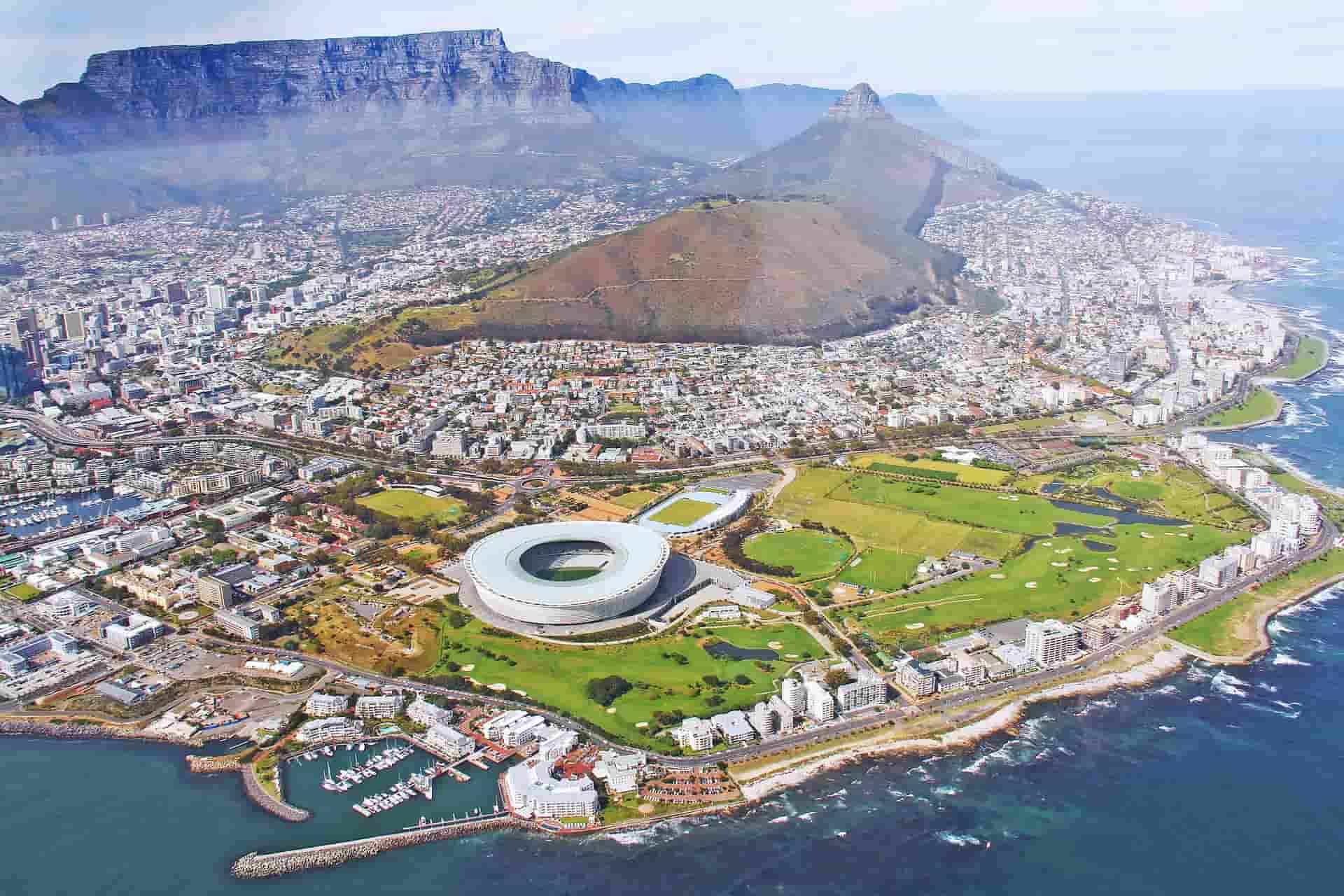
Cape Town International Airport (IATA: CPT, ICAO: FACT) is the primary international airport serving the city of Cape Town, and is the second-busiest airport in South Africa and fourth-busiest in Africa. Located approximately 20 kilometres (12 mi) from the city center, the airport was opened in 1954 to replace Cape Town’s previous airport, Wingfield Aerodrome. Cape Town International Airport is the only airport in the Cape Town metropolitan area that offers scheduled passenger services. The airport has domestic and international terminals, linked by a common central terminal.
The airport has direct flights from South Africa’s other two main urban areas, Johannesburg and Durban, as well as flights to smaller centres in South Africa. Internationally, it has direct flights to several destinations in Africa, the Middle East, Asia, Europe and the United States. The air route between Cape Town and Johannesburg was the world’s ninth-busiest air route in 2011 with an estimated 4.5 million passengers.
History
D.F. Malan Airport was opened in 1954, a year after Jan Smuts Airport (now OR Tambo International Airport) on the Witwatersrand, near Johannesburg, opened. The airport replaced Cape Town’s previous airport, Wingfield Aerodrome. Originally named after the then South African prime minister, it initially offered two international flights: a direct flight to Britain and a second flight to Britain via Johannesburg. By 1977, the airport had acquired nonstop connectivity with South America, with Varig operating flights to Rio de Janeiro.
With the fall of apartheid in the early 1990s, ownership of the airport was transferred from the state to the newly formed Airports Company South Africa,[4] and the airport was renamed to the politically neutral Cape Town International Airport.[5] Additionally, South African Airways launched a route to North America in 1992, linking Cape Town to Miami.[6] The destination of this flight later changed to Fort Lauderdale and finally to Atlanta.
The first years of the twenty-first century saw tremendous growth at the airport; from handling 6.2 million passengers per annum in 2004–05, the airport peaked at 8.4 million passengers per annum in 2007–08 before falling back to 7.8 million in 2008–09.[citation needed] On the other hand, South African Airways had terminated the flight to Atlanta by 2006.[9] In 2011, Malaysia Airlines withdrew its service to Buenos Aires, which had begun in the 1990s.
In 2016, the airport saw a 29% increase in international arrivals; 2016 also saw the airport handle 10 million passengers per annum.[citation needed] Three years later, a new connection to North America commenced upon United Airlines’ arrival from Newark.
Name change
On 16 April 2018, it was reported in the Cape Times that the Minister of Transport, Bonginkosi Nzimande, had directed ACSA on 22 March 2018 to change the name of Cape Town International Airport to Nelson Mandela International Airport. The name change was discussed and as yet no name change had been published in the Government Gazette.
On 5 March 2019, the EFF filed a motion in Parliament calling for the renaming of Cape Town International Airport after anti-apartheid icon Winnie Madikizela-Mandela. Whilst members of the Khoi community pushed for the airport to be named after the !Uriǁ’aeǀona translator and cultural icon Krotoa. One of the arguments of the opposition was that the Parliament is not constitutionally empowered to resolve on any name change and that it was the responsibility of the South African Geographical Names Council (SAGNC) to deal with name changes. The motion was not successful.
Until a name change has been published in the Government Gazette, it remains Cape Town International Airport. In February 2021, the Cape Times reported that the proposed name change of the airport had been “quietly ditched”.
Developments
In preparation for the 2010 FIFA World Cup, Cape Town International Airport was extensively expanded and renovated. The main focus was the development of a Central Terminal Building at a cost of R1.6 billion,[18] which linked the formerly separate domestic and international terminals and provided a common check-in area. The departures level of the Central Terminal opened in November 2009, with the entire building opened in April 2010.
Apart from the completion of the 2010 expansion project, it had been proposed that a second runway for large aircraft be constructed at the airport, to be completed by 2015. However, this second runway has not been constructed. In May 2015, Airports Company South Africa announced a R7.7 billion expansion for the airport. The expansion includes the upgrades of the Domestic & International terminals. The expansion has been postponed indefinitely due to the drop in passenger numbers due to the global covid-19 pandemic.[20]
Terminal
The airport has two terminals linked by the central terminal.
- Central Terminal
The terminal building has a split-level design, with departures located on the upper floors and arrivals in the lower floors; an elevated roadway system provides vehicular access to both departures and arrivals levels.[19] All check-in takes place within the Central Terminal Building, which contains 120 check-in desks and 20 self-service kiosks. Passengers then pass through a consolidated security screening area before dividing. Passengers flying internationally head to the northern part of the airport which is the international terminal, and passengers flying to other parts of South Africa head to the southern part of the airport to the domestic terminal.
The terminal has 10 air bridges, evenly split between domestic and international usage. Sections of lower levels of the domestic and international terminals are used for transporting passengers via bus to and from remotely parked aircraft.
Arriving passengers collect luggage in the old sections of their respective terminals, before proceeding through new passageways to the new Central Terminal Building. The terminal contains an automated baggage handling system, capable of handling 30,000 bags per hour.
Retail outlets are located on the lower (arrivals) level of the terminal at landside, as well as airside at the departure gates. Retail outlets are diverse, including foreign exchange services, bookstores, clothing retailers, grocery stores, souvenir outlets and duty-free in international departures. Restaurants within the terminal building are located on the upper (3rd) level above the departures level, which includes what is purported to be the largest Spur restaurant on the African continent, at 1,080 m2 (11,600 sq ft). The restaurant level overlooks the airside of the terminal, where a glass curtain wall separates the patrons from the planes three stories below. On the 4th floor is where the airport’s lounges are situated. The Bidvest, as well as South African Airways lounges, can be found here.
- International Terminal
The international terminal is located on the northern side of the airport. Customs and Immigration facilities, lounges, duty-free shops, restaurants, prayer rooms, conference rooms, airline offices, and chapels are located in the terminal.
- Domestic Terminal
Located on the southern side of the airport, it has the same facilities as the international terminal, with the exception of Immigration facilities.
Other facilities
There are two hotels located within the airport precinct: Hotel Verde, a four-star hotel owned by Bon Hotels and ranked as “Africa’s greenest hotel”, and the other being Road Lodge, a budget hotel owned by the City Lodge hotel chain group. An ExecuJet facility is located near the southern end of the main runway and caters for business jets. The airport also has a MyCiti BRT station which connects across the whole of Cape Town, including east of Khayelitsha.
All From Wikipedia. Main Page
Search Hotels on map In Cape Town