
Colorado Denver International Airport





Search Cheap flights to Colorado Denver International Airport


Prices for current month
Denver
Colorado Denver International Airport
Denver International Airport (IATA: DEN, ICAO: KDEN, FAA LID: DEN), locally known as DIA, is an international airport in the Western United States, primarily serving metropolitan Denver, Colorado, as well as the greater Front Range Urban Corridor. At 33,531 acres (52.4 sq mi; 135.7 km2), it is the largest airport in North America by land area and the second largest in the world, behind King Fahd International Airport. Runway 16R/34L, with a length of 16,000 feet (3.03 mi; 4.88 km), is the longest public use runway in North America and the seventh longest in the world. The airport is 25 miles (40 km) driving distance from Downtown Denver, 19 miles (31 km) further than the former Stapleton International Airport, the facility DEN replaced: the airport is actually closer to the City of Aurora than central Denver, and many airport-related services, such as hotels, are located in Aurora.
Opened in 1995, DEN currently has non-stop service to 215 destinations amongst 23 different airlines throughout North America, Latin America, Europe, and Asia; it was the fourth airport in the U.S. to exceed 200 destinations.[7] The airport is a hub for both United Airlines and Frontier Airlines and is one of the largest operating bases for Southwest Airlines.[8] With over 35,000 employees, the airport is the largest employer in Colorado. The airport is located on the western edge of the Great Plains and within sight of the Front Range of the Rocky Mountains.
In 2021, DEN was the third busiest airport in the world as well as the third busiest airport in the United States by passenger traffic; DEN has been among the top 20 busiest airports in the world every year since 2000.
History
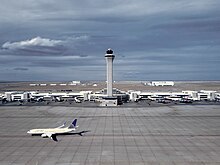
The Air Traffic Control Tower and Concourse C at Denver International Airport with a United Airlines Boeing 737-800 taxiing below
Denver has traditionally been home to one of the busier airports in the United States because its midcontinent location was ideal for an airline hub. Several airlines, notably United Airlines and Continental Airlines were hubbed at the former Stapleton International Airport, helping make it the sixth-busiest airport in the country by the 1960s. But Stapleton was cramped, with little room to add additional flights and with runways too close together, leading to long waits in bad weather that would cause nationwide travel disruptions.
From 1980 to 1983, the Denver Regional Council of Governments investigated areas for a new area airport north and east of Denver. Meanwhile in 1983, Federico Peña was elected mayor of Denver, campaigning on a plan to expand Stapleton onto Rocky Mountain Arsenal lands. The plan had broad support, but leaders in nearby Adams County threatened to sue over noise concerns.
Eventually Peña struck a deal: Adams County leaders would rally citizens to back a plan for Denver to annex 54 square miles (140 km2) of the county to build an airport away from established neighborhoods. In 1988, Adams County voters approved the annexation. The proposal was met with some skepticism because of its location: 24 miles (39 km) from the heart of the city. But seeing the importance of a Denver air hub to the national transportation system, the federal government put $500 million (equivalent to $1.1 billion today) toward the new airport. The rest of the cost would be financed by bonds, to be repaid with fees on airlines.[10] Ground was broken in September 1989.
Two years later, Mayor Wellington Webb inherited the megaproject, which at that time was scheduled to open on October 29, 1993. At the time United was refusing to move to the new airport over the high proposed fees. The airline finally relented under the condition that the airport include an automated baggage system.
Construction delays pushed opening day back, first to December 1993, then to March 1994. By September 1993, delays due to a millwright strike and other events meant opening day was pushed back again, to May 1994.
In April 1994, the city invited reporters to observe the first test of the new automated baggage system. Reporters were treated to scenes of clothing and other personal effects scattered beneath the system’s tracks and carts that would often toss the luggage right off the system. After the embarrassing preview, the mayor cancelled the planned May opening. The baggage system continued to be a maintenance hassle and was finally terminated in September 2005, with traditional baggage handlers manually handling cargo and passenger luggage.
DEN finally replaced Stapleton on February 28, 1995, 16 months behind schedule and at a cost of $4.8 billion (equivalent to $8.5 billion today), nearly $2 billion over budget ($3.6 billion today). The construction employed 11,000 workers. United Airlines Flight 1062 to Kansas City International Airport was the first to depart DIA and United Flight 1474 from Colorado Springs Airport was the first to arrive at the new airport.
In September 2003, runway 16R/34L was added, the airport’s sixth and at 16,000 ft (3.0 mi; 4.9 km), it is 4,000 ft (0.76 mi; 1.2 km) longer than the other runways. Its length, exceeded by only six other runways in the world, allows fully-laden Airbus A380s and Boeing 747-8s to take off in the hot and high conditions at the airport, which is roughly 1 mi (1.6 km) above sea level.
During a blizzard on March 17–19, 2003, the weight of heavy snow tore a hole in the terminal’s white fabric roof, and over 2 feet (0.61 m) of snow on paved areas closed the airport and its main access road (Peña Boulevard) for almost two days, stranding several thousand people. Another blizzard on December 20–21, 2006, dumped over 20 inches (51 cm) of snow in about 24 hours. The airport was closed for more than 45 hours, stranding thousands. Following this, the airport invested heavily in new snow-removal equipment that has led to a dramatic reduction in runway occupancy times to clear snow, down from an average of 45 minutes in 2006 to just 15 minutes in 2014.
After shunning DEN for over a decade due to high fees, Southwest Airlines entered the airport in January 2006 with 13 daily flights. Southwest has since rapidly expanded and is now the airport’s second-largest carrier after United.
In the 2010s, a transit center and hotel were added to the main Jeppesen Terminal. The hotel opened on November 19, 2015 and on April 22, 2016, commuter rail trains started operating between the airport and Denver Union Station on RTD’s A Line.
On September 9, 2015, a political campaign was launched by Mayor Michael Hancock to radically expand commercial development at DIA, previously prohibited by intergovernmental agreement between Denver and Adams County. The changes to the agreement were approved by both Denver and Adams County voters in November 2015.
In 2018, work began on a major interior renovation and reconfiguration including the beginning phases of construction to relocate two out of the three TSA security checkpoints from the Great Hall on Level 5 to Level 6 (East & West) while simultaneously updating and consolidating airline ticket counters/check-in for all airlines. Eventually, both pre- and post-security gathering and leisure areas will be incorporated into the spaces where both expansive TSA security areas on Level 5 are currently located. The third TSA security checkpoint currently accessible via the Concourse A bridge is expected to be removed. The renovation and reconfiguration will bring back the original intent and use of the Great Hall as a large commons area for airport patrons and visitors to enjoy. This phased terminal project is expected to be completed by 2025.
Additionally, work is underway on expanding all three concourses, with 12 new gates being added to A (including several gates with direct access to U.S. Customs and Border Protection), 11 to B, and 16 to C for a total of 39 gates. Following the completion of this project, United Airlines will lease 24 additional gates on both A and B (bringing its total gate count at DEN to around 90), as well as build a new United Club in A and expand their existing clubs in B. Southwest Airlines will lease 16 of the new gates on C bringing its total gate count at DEN to 40. When both the ongoing terminal and concourse projects are completed, the airport will be able to handle upwards of 90 million passengers per year. In 2021, the Airport experienced a notable failure of the train system. In response, a request for information from the private sector was issued to analyze options to possibly supplement the train system in the future.
In 2022, a committee was formed to support efforts to establish flights between Denver and the African continent.
Facilities
The airport is 25 miles (40 km) driving distance from Downtown Denver, which is 19 miles (31 km) farther away than Stapleton International Airport, the airport DIA replaced. The distant location was chosen to avoid aircraft noise affecting developed areas, to accommodate a generous runway layout that would not be compromised by blizzards, and to allow for future expansion.
The 52.4 square miles (136 km2; 33,500 acres) of land occupied by the airport is more than one and a half times the size of Manhattan (33.6 square miles or 87 square kilometres). DIA occupies the largest amount of commercial airport land area in North America, by a great extent. The land was transferred from Adams County to Denver after a 1989 vote, increasing the city’s size by 50 percent and bifurcating the western portion of the neighboring county. All freeway traffic accessing the airport from central Denver leaves the city and passes through Aurora for nearly two miles (3.2 km), making the airport a practical exclave. Similarly, the A Line rail service connecting the airport with downtown Denver has two intervening stations in Aurora.
Terminal
DIA has one terminal, named The Jeppesen Terminal after aviation safety pioneer Elrey Borge Jeppesen, and three midfield concourses, spaced far apart. The three midfield concourses have a total of 146 gates.[31] Concourse A is accessible via a pedestrian bridge directly from the terminal building, as well as via the underground train system that services all three concourses. For access to Concourses B and C, passengers must utilize the train. All international arrivals without border pre-clearance are processed in Concourse A; this concourse also has 4 3-jetway international gates that can support ADG Group VI aircraft such as an Airbus A380 and a Boeing 747-8, the two largest commercial aircraft in the world.
- Concourse A has 51 gates, including several ground level boarding slips.
- Concourse B has 88 gates.
- Concourse C has 29 gates.
United operates two United Clubs in Concourse B and will be opening one in Concourse A soon. American Airlines and Delta Air Lines operate an Admirals Club and Sky Club respectively in Concourse A. American Express operates a Centurion Lounge in Concourse C. Capital One is set to open a Capital One Lounge in Concourse A in 2022.
Art and aesthetics
The Jeppesen Terminal’s internationally recognized peaked roof, designed by Fentress Bradburn Architects, resembles snow-capped mountains and evokes the early history of Colorado when Native American teepees were located across the Great Plains. The catenary steel cable system, similar to the Brooklyn Bridge design, supports the fabric roof. DIA is also known for a pedestrian bridge connecting the terminal to Concourse A that allows travelers to walk from the main Terminal to Concourse A, while viewing planes taxiing beneath them. It offers views of the Rocky Mountains to the west and the high plains to the east.
Both during construction and after opening, DIA has set aside a portion of its construction and operation budgets for art. The corridor from the main terminal and Concourse A frequently displays temporary art exhibits. A number of public artworks are present in the underground train that links the main terminal with concourses, including art pieces from the history of Colorado.
The airport features a bronze statue of Denver native Jack Swigert by Loveland, Colorado artist George Lundeen in Concourse B. Swigert flew on Apollo 13 as Command Module Pilot, and was elected to the House of Representatives in 1982, but died of cancer before he was sworn in. The statue is dressed in an A7L pressure suit, and is posed holding a gold-plated helmet. It is a duplicate of a statue placed at the United States Capitol in 1997. George Lundeen is also the sculptor of “The Aviator”, a monumental bronze sculpture of Elrey Borge Jeppesen, for whom the terminal is named.
Denver International Airport has four murals, all of which have been the topic of conspiracy theorists and debate. The murals are ambiguous in meaning, depicting scenes including caged animals, fires, suffering people, and a soldier with a blade and a gas mask. They have been interpreted in the past by onlookers to represent war, hope, and even the New World Order.
In March 2019, the airport unveiled an animated, talking gargoyle in the middle of one of the concourses. The gargoyle interacts with passengers and jokes about the supposed conspiracies connected to the airport.
Blue Mustang, by El Paso-born artist Luis Jiménez, was one of the earliest public art commissions for Denver International Airport in 1993. The 32-foot-tall (9.8 m) sculpture is a bright blue cast-fiberglass sculpture of a horse with glowing red eyes located between the inbound and outbound lanes of Peña Boulevard. Jiménez was killed in 2006 at age 65 while creating the sculpture when a part of it fell on him and severed an artery in his leg. At the time of his death, Jiménez had completed painting the head of the mustang. Blue Mustang was completed by others, and unveiled at the airport on February 11, 2008. The statue has been the subject of considerable controversy, and has acquired the nickname Blucifer for its demonic appearance. The sculpture has been defended and disparaged by many people.
Ground transportation
Main article: Denver Airport station
The Regional Transportation District (RTD) operates the A Line rail service between DIA and Denver Union Station in downtown Denver, making the 37 minute trip about every 15 minutes. RTD also operates an airport express bus service called skyRide between Arapahoe County or Boulder and DIA. There is also hourly service to Thornton on RTD route 104L, a limited stop bus. The airport is also served by two commuter routes with just a few runs per day: RTD route 145X to Brighton and 169L to Aurora.
Scheduled bus service is also available to points such as Fort Collins, and van services stretch into Nebraska, Wyoming, and Colorado summer and ski resort areas. Amtrak offers a Fly-Rail plan for ticketing with United Airlines for trips into scenic areas in the Western U.S. via a Denver stopover.
The airport is connected to the I-70 and Denver via the Peña Boulevard freeway. A number of car rental companies are located at the airport, providing courtesy shuttle services from Jeppesen Terminal Level 5, Island 4, to their parking areas.
All From Wikipedia. Main Page
Musement, Book tickets and experiences all over the world
Top Hotels in Colorado Denver
People also ask
Lowest Price offers of flights
Search Flights on map
Special Flight deals to North America