NEW YORK John F. Kennedy International Airport





Search Cheap flights to NEW YORK John F. Kennedy International Airport


Prices for current month
NEW YORK John F. Kennedy International Airport
New York John F. Kennedy International Airport
John F. Kennedy International Airport (IATA: JFK, ICAO: KJFK, FAA LID: JFK) (colloquially referred to as JFK Airport, Kennedy Airport, New York-JFK, or simply JFK) is the main international airport serving New York City. The airport is the busiest of the six airports in the New York airport system, the 13th-busiest airport in the United States, and the busiest international air passenger gateway into North America.[5] More than ninety airlines operate from the airport, with nonstop or direct flights to destinations in all six inhabited continents.
JFK is located in the Jamaica neighborhood of Queens, 16 miles (26 km) southeast of Midtown Manhattan. The airport features six passenger terminals and four runways. JFK is a hub for both American Airlines and Delta Air Lines, and it is the primary operating base for JetBlue. JFK was also formerly a hub for Pan Am, TWA, Eastern, National, Northwest, and Tower Air.
The facility opened in 1948 as New York International Airport and was commonly known as Idlewild Airport. Following U.S. President John F. Kennedy’s assassination in 1963, the airport was renamed John F. Kennedy International Airport as a tribute to the 35th President.
History
Construction
John F. Kennedy International Airport was originally called Idlewild Airport (IATA: IDL, ICAO: KIDL, FAA LID: IDL) after the Idlewild Beach Golf Course that it displaced. It was built to relieve LaGuardia Field, which had become overcrowded after its 1939 opening. In late 1941, mayor Fiorello La Guardia announced that the city had tentatively chosen a large area of marshland on Jamaica Bay, which included the Idlewild Golf Course as well as a summer hotel and a landing strip called the Jamaica Sea-Airport, for a new airfield.
Title to the land was conveyed to the city at the end of December 1941. Construction began in 1943, though the airport’s final layout was not yet decided upon.
About US$60 million was initially spent with governmental funding, but only 1,000 acres (400 ha) of the Idlewild Golf Course site were earmarked for use.
The project was renamed Major General Alexander E. Anderson Airport in 1943 after a Queens resident who had commanded a Federalized National Guard unit in the southern United States and died in late 1942. The renaming was vetoed by Mayor La Guardia and reinstated by the New York City Council; in common usage, the airport was still called “Idlewild”.[21] In 1944, the New York City Board of Estimate authorized the condemnation of another 1,350 acres (550 ha) for Idlewild. The Port of New York Authority (now the Port Authority of New York and New Jersey) leased the Idlewild property from the City of New York in 1947 and maintains this lease today. In March 1948, the City Council changed the official name to New York International Airport, Anderson Field, but the common name remained “Idlewild” until December 24, 1963.
The airport was intended as the world’s largest and most efficient, with “no confusion and no congestion”.
Separate terminals
By 1954, Idlewild had the highest volume of international air traffic of any airport globally.
The Port of New York Authority originally planned a single 55-gate terminal, but the major airlines did not agree with this plan, arguing that the terminal would be far too small for future traffic.[34] Architect Wallace Harrison then designed a plan for each major airline at the airport to be given its own space to develop its own terminal.[35] This scheme made construction more practical, made terminals more navigable, and introduced incentives for airlines to compete with each other for the best design.
The revised plan met airline approval in 1955, with seven terminals initially planned. Five terminals were for individual airlines, one was for three airlines, and one was for international arrivals. (National Airlines and British Airways arrived later.) In addition, there would be an 11-story control tower, roadways, parking lots, taxiways, and a reflecting lagoon in the center. The airport was designed for aircraft up to 300,000-pound (140,000 kg) gross weight
The airport had to be modified in the late 1960s to accommodate the Boeing 747’s weight.
The International Arrivals Building, or IAB, was the first new terminal at the airport, opening in December 1957. The building was designed by Skidmore, Owings, and Merrill (SOM). The terminal stretched nearly 2,300 feet (700 meters) and was parallel to runway 7R. The terminal had “finger” piers at right-angles to the main building allowing more aircraft to park, an innovation at the time. The building was expanded in 1970 to accommodate jetways. However, by the 1990s the overcrowded building was showing its age and it did not provide adequate space for security checkpoints. It was demolished in 2000 and replaced with Terminal 4.
United Airlines and Delta Air Lines opened Terminal 7 (later renumbered Terminal 9), a SOM design similar to the IAB, in October 1959. It was demolished in 2008.
Eastern Airlines opened their Chester L. Churchill-designed Terminal 1 in November 1959. The terminal was demolished in 1995 and replaced with the current Terminal 1.
American Airlines opened Terminal 8 in February 1960. It was designed by Kahn and Jacobs and had a 317-foot (97 m) stained-glass facade designed by Robert Sowers, the largest stained-glass installation in the world until 1979. The facade was removed in 2007 as the terminal was demolished to make room for the new Terminal 8; American cited the prohibitive cost of removing the enormous installation.
Pan American World Airways opened the Worldport (later Terminal 3) in 1960, designed by Tippetts-Abbett-McCarthy-Stratton. It featured a large, elliptical roof suspended by 32 sets of radial posts and cables; the roof extended 114 feet (35 m) beyond the base of the terminal to cover the passenger loading area. It was one of the first airline terminals in the world to feature jetways that connected to the terminal and that could be moved to provide an easy walkway for passengers from the terminal to a docked aircraft. Jetways replaced the need to have to board the plane outside via airstairs which descend from an aircraft, truck-mounted mobile stairs, or wheeled stairs. The Worldport was demolished in 2013.
Trans World Airlines opened the TWA Flight Center in 1962, designed by Eero Saarinen with a distinctive winged-bird shape. With the demise of TWA in 2001, the terminal remained vacant until 2005 when JetBlue and the Port Authority of New York and New Jersey (PANYNJ) financed the construction of a new 26-gate terminal partly encircling the Saarinen building. Called Terminal 5 (Now T5), the new terminal opened October 22, 2008. T5 is connected to the Saarinen central building through the original passenger departure-arrival tubes that connected the building to the outlying gates. The original Saarinen terminal, also known as the head house, has since been converted into the TWA Hotel.
Northwest Airlines, Braniff International, and Northeast Airlines opened a joint terminal in November 1962 (now Terminal 2).
National Airlines opened the Sundrome (later Terminal 6) in 1969. The terminal was designed by I.M.Pei. It was unique for its use of all-glass mullions dividing the window sections, unprecedented at the time. In 2001, United Airlines planned to redevelop this terminal and the TWA Flight Center as a new United terminal. Terminal 6 was used by JetBlue from 2001 until JetBlue moved to Terminal 5 in 2008. The Sundrome was demolished in 2011.
Later operation
The airport was renamed John F. Kennedy International Airport on December 24, 1963, a month and two days after the assassination of President John F. Kennedy; Mayor Robert F. Wagner, Jr. proposed the renaming. The IDL and KIDL codes have since been reassigned to Indianola Municipal Airport in Mississippi.
Airlines began scheduling jets to Idlewild in 1958–59; LaGuardia did not get jets until 1964, and JFK became New York’s busiest airport. It had more airline takeoffs and landings than LaGuardia and Newark combined from 1962 to 1967 and was the second-busiest airport in the country, peaking at 403,981 airline operations in 1967. LaGuardia received a new terminal and longer runways from 1960 to 1966. By the mid- 1970s, the two airports had roughly equal airline traffic (by flight count); Newark was in third place until the 1980s, except during LaGuardia’s reconstruction. Concorde, operated by Air France and British Airways, made scheduled trans-Atlantic supersonic flights to JFK from November 22, 1977, until its retirement by British Airways on October 24, 2003. Air France had retired the aircraft in May 2003.
Construction of the AirTrain JFK people-mover system began in 1998, after decades of planning for a direct rail link to the airport. Although the system was originally scheduled to open in 2002,[63] it opened on December 17, 2003 after delays caused by construction and a fatal crash. The rail network links each airport terminal to the New York City Subway and the Long Island Rail Road at Howard Beach and Jamaica.
The airport’s new Terminal 1 opened on May 28, 1998; Terminal 4, the $1.4 billion replacement for the International Arrivals Building, opened on May 24, 2001. JetBlue’s Terminal 5 incorporates the TWA Flight Center, and Terminals 8 and 9 were demolished and rebuilt as Terminal 8 for the American Airlines hub. The Port Authority Board of Commissioners approved a $20 million planning study for the redevelopment of Terminals 2 and 3, the Delta Air Lines hub, in 2008.
On March 19, 2007, JFK was the first airport in the United States to receive a passenger Airbus A380 flight. The route, with an over-500-passenger capacity, was operated by Lufthansa and Airbus and arrived at Terminal 1. On August 1, 2008, it received the first regularly-scheduled commercial A380 flight to the United States (on Emirates’ New York–Dubai route) at Terminal 4. Although the service was suspended in 2009 due to poor demand, the aircraft was reintroduced in November 2010. Airlines operating A380s to JFK include Singapore Airlines (on its New York–Frankfurt–Singapore route), Air France (on its New York–Paris route), Lufthansa (on its New York–Frankfurt route), Korean Air (on its New York–Seoul route), Asiana Airlines (on its New York–Seoul route), Etihad Airways on its New York–Abu Dhabi route, and Emirates (on its New York–Milan–Dubai and New York–Dubai routes). On December 8, 2015, JFK was the first U.S. airport to receive a commercial Airbus A350 flight when Qatar Airways began using the aircraft on one of its New York–Doha routes.
On August 14, 2016, at 9:31 pm, gunfire was reported at Terminal 8; shortly afterward, gunfire was also reported at Terminal 1. An investigation indicated that no shooting had occurred, but frightened travelers ran from the terminals onto nearby highways and runways. The terminals were temporarily shut down, and flights were rerouted. Police, who were investigating, learned that the reported gunshots were travelers clapping for Usain Bolt after he won the men’s 100-meter dash at the 2016 Summer Olympics. Two people were injured in the resulting stampede, and the Port Authority Police Department later reviewed its strategy for dealing with possible terror attacks
Reconstruction
On January 4, 2017, the office of then New York governor Andrew Cuomo announced a plan to renovate most of the airport’s existing infrastructure at a cost of $7 to $10 billion. The Airport Master Plan Advisory Panel had reported that JFK, ranked 59th out of the world’s top 100 airports by Skytrax, was expected to experience severe capacity constraints from increased use. The airport was expected to serve about 75 million annual passengers in 2020 and 100 million by 2050, up from 60 million when the report was published. The panel had several recommendations, including enlarging the newer terminals; relocating older terminals; reconfiguring highway ramps and increasing the number of lanes on the Van Wyck Expressway; lengthening AirTrain JFK trainsets or connecting the line to the New York City transportation system, and rebuilding the Jamaica station with direct connections to the Long Island Rail Road and the New York City Subway. No start date has yet been proposed for the project; in July 2017, Cuomo’s office began accepting proposals for master plans to renovate the airport. When all the construction is finished, the airport will have 149 total gates- 145 with jetways and 4 hardstands.
New Terminal 1
In October 2018, Cuomo released details of a $13 billion plan to rebuild passenger facilities and approaches to JFK Airport. Two all-new international terminals would be built. One of the terminals, a $7 billion, 2.8-million-square-foot (260-thousand-square-metre), 23-gate structure replacing terminals 1 and 2 (and the vacant space of Terminal 3) and connecting to Terminal 4, would be financed and built by a partnership between Munich Airport Group, Lufthansa, Air France, Korean Air, and Japan Airlines. Of these 23 gates, all are international gates, 22 are widebody gates (4 can accommodate an Airbus A380), and 1 is a narrowbody gate. This would also require the reconfiguring new roads to accommodate the new terminal.
On December 13, 2021, New York Governor Kathy Hochul gave a further update on the plans to build a new Terminal 1, which in a further developed form would cost US$9.5 billion. The new facility is taking inspiration from the new Terminal B at LaGuardia Airport, and the new terminal will have New York City-inspired art throughout it similar to Terminal B at LGA. Once Terminal 2 is demolished and Delta’s regional flights are transferred to an expanded Terminal 4, the New Terminal 1 will begin construction, and will then open in phases with the first 14 gates on its east side along with the departures and arrivals hall scheduled to open in 2026 on the site of the demolished Terminal 2. The current Terminal 1 will then be demolished, and in its place the next 5 gates on the west side of the terminal will open in 2028, and the final 4 gates will open in 2030. An additional extension of the terminal on its west side with an additional 4 gates (with an additional A380 gate) has been proposed in the event of excess traffic. The project is scheduled to begin in mid-2022.
Expanded Terminal 4
On February 11, 2020, Cuomo and the Port Authority, along with Delta Air Lines, announced a $3.8 billion plan to add sixteen domestic regional gates to the ‘A’ side of Terminal 4, replacing Terminal 2. The main headhouse will be expanded to accommodate additional passengers and would open in 2022. The sixteen new gates will open in 2023, allowing the demolition of Terminal 2, the consolidation of flights for Delta, and the ability to build the new Terminal 1. An expanded roadway will be completed in 2025. This would bring the total gates of this terminal from 38 to 54.
New Terminal 6
The other terminal, a new Terminal 6 with 10 new wide-body gates costing $3 billion, would be built by a consortium including JetBlue, RXR Realty, and Vantage Airport Group known as JFK Millennium Partners, and will replace Terminal 7 and the vacant space of Terminal 6, and would connect to Terminal 5. Terminal 8 would remain a separate terminal operating American Airlines and Oneworld flights, the airline alliance AA is a member of. JFK’s redesign will include adding cars to AirTrain trainsets; widening connector ramps between the Van Wyck Expressway and Grand Central Parkway in Kew Gardens; and adding another lane in each direction to the Van Wyck, at a combined cost of $1.5 billion. Under the plan, the first gates would open in 2023, and the project would be complete in 2025.
Expanded Terminal 8
In 2019, it was announced that British Airways and Iberia will move into Terminal 8 preceding the demolition of Terminal 7, and that the terminal would be expanded and changed to accommodate more widebody aircraft that British Airways, Iberia and other OneWorld airlines regularly send to JFK. On January 7, 2020, construction began on expanding and improving Terminal 8. Following the construction, British Airways and Iberia will move into Terminal 8. This construction will be the first phase in the airport’s expansion; the airport will have the same amount of gates as before, plus 4 hardstands.
Access
Rail
Main article: AirTrain JFK
All lines of AirTrain JFK, the airport’s dedicated rail network, stop at each passenger terminal. The system also serves Federal Circle, the JFK long-term parking lot, and two multimodal rapid transit stations: Howard Beach and Jamaica. While AirTrain travel within airport property is complementary, external transfers at the latter two locations are paid via MetroCard and provide access to the New York City Subway, Long Island Rail Road, and MTA Bus services.
Bus
As of 2021, several MTA bus lines (Q3, Q10, B15) serve the airport’s Central Terminal Area via a dedicated bus stop at the former Terminal 6. Additional lines (Q6, Q7) serve JFK’s cargo terminals. Bus fares are paid via MetroCard or OMNY systems, with free transfers provided to New York City Subway services.
Car
Vehicles primarily access the airport via the Van Wyck Expressway (I-678) or JFK Expressway, both of which are connected to the Belt Parkway and various surface streets in South Ozone Park and Springfield Gardens. The airport operates parking facilities consisting of multi-level terminal garages, surface spaces in the Central Terminal Area, and a long-term parking lot with total accommodation for more than 17,000 vehicles. A travel plaza on airport property also contains a food court, filling station, and four Tesla Superchargers.
Taxis and other for-hire vehicles (FHV) serving JFK are licensed by the New York City Taxi & Limousine Commission. In 2019, PANYNJ approved the implementation of “airport access fee” surcharges on FHV and taxi trips, with the revenue earmarked to support the agency’s capital programs.
Facilities
Terminals
JFK has six terminals, containing 131 gates in total. The terminals are numbered 1–8 but skipping terminals 3 (demolished in 2013) and 6 (demolished in 2011).
The terminal buildings, with the exception of the former Tower Air terminal, are arranged in a deformed U-shaped wavy pattern around a central area containing parking, a power plant and other airport facilities. The terminals are connected by the AirTrain system and access roads. Directional signage throughout the terminals was designed by Paul Mijksenaar. A 2006 survey by J.D. Power and Associates in conjunction with Aviation Week found JFK ranked second in overall traveler satisfaction among large airports in the United States, behind Harry Reid International Airport, which serves the Las Vegas metropolitan area.
Until the early 1990s, each terminal was known by the primary airline that served it, except for Terminal 4, which was known as the International Arrivals Building. In the early 1990s, all of the terminals were given numbers except for the Tower Air terminal, which sat outside the Central Terminals area and was not numbered. Like in the other airports controlled by the Port Authority, terminals are sometimes managed and maintained by independent terminal operators. At JFK, all terminals are currently managed by airlines or consortiums of the airlines serving them, with the exception of the Schiphol Group-operated Terminal 4. All terminals except Terminal 2 can handle international arrivals that are not pre-cleared.
Most inter-terminal connections require passengers to exit security, then walk, use a shuttle bus, or use the AirTrain JFK to get to the other terminal, then re-clear security.
erminal 1

Terminal 1
Terminal 1 opened in 1998, 50 years after the opening of JFK, at the direction of the Terminal One Group, a consortium of four key operating carriers: Air France, Japan Airlines, Korean Air, and Lufthansa. This partnership was founded after the four airlines reached agreement that the then-existing international carrier facilities were inadequate for their needs.
Terminal 1 is served by SkyTeam carriers Aeroflot, Air France, China Eastern Airlines, ITA Airways, Korean Air, and Saudia; Star Alliance carriers Asiana Airlines, Air China, Austrian Airlines, Brussels Airlines, EVA Air, Lufthansa, Swiss International Air Lines, TAP Air Portugal, and Turkish Airlines; and Oneworld carriers Japan Airlines and Royal Air Maroc. Other airlines serving terminal 1 include Air Senegal, Air Serbia, Azerbaijan Airlines, Azores Airlines, Cayman Airways, Eastern Airlines, Flair Airlines, Neos, Philippine Airlines, Sky Cana, VivaAerobus, and Volaris.
Terminal 1 was designed by William Nicholas Bodouva + Associates. It and Terminal 4 are the two terminals at JFK Airport with the capability of handling the Airbus A380 aircraft, which are flown by Lufthansa on the route from Frankfurt Airport, and by Korean Air on the route from Seoul–Incheon. Air France operated Concorde here until 2003.[99] Terminal 1 has 11 gates.
Terminal 2
Terminal 2 opened in 1962 as the home of Northeast Airlines, Braniff, and Northwest Airlines, and is currently occupied by Delta Air Lines. The facility contains 11 jetbridge-equipped gates (C60–C70), one mezzanine-level airline club, and it formerly housed several hardstands for smaller regional airliners. As the only terminal without a U.S. Customs and Border Protection processing facility, T2 is unable to accept any international flights arriving unless subject to US Customs preclearance.
After the demise of Northeast Airlines and Braniff, the terminal was taken over by Pan Am and subsequently Delta. Upon the completion of Terminal 4, T2’s gates were prefaced with the letter ‘C’, and airside shuttle buses provided passenger connectivity between the terminals. Prior to 2013, Terminal 2 hosted the majority of Delta’s operations in conjunction with Terminal 3, but the 2013–2015 expansion of Terminal 4 allowed the airline to consolidate most of its operation in the new larger facility, including international and transcontinental flights.[101] In mid-2020, following drastic schedule reductions in the wake of the COVID-19 pandemic, Delta suspended all operations from Terminal 2.[102] In April 2021, the Port Authority finalized plans to expand Terminals 1 and 4 and demolish Terminal 2 at an unspecified date.[103] Terminal 2 is expected to be vacant by 2022, and the renovated Terminal 1 will occupy its former footprint. As of July 2021, the facility has been re-opened to Delta flights.
Terminal 4

Terminal 4 replaced the former International Arrivals Building in May 2001
Terminal 4, developed by LCOR, Inc., is managed by JFK International Air Terminal (IAT) LLC, a subsidiary of the Schiphol Group and was the first in the United States to be managed by a foreign airport operator. Terminal 4 currently contains 38 gates in two concourses and functions as the hub for Delta at JFK. Concourse A (A2–A7) serves primarily Asian and some European airlines, while Concourse B primarily serves both domestic & international flights of Delta Air Lines and its Skyteam partners.
Airlines servicing Terminal 4 include SkyTeam carriers Aeromexico, Air Europa, China Airlines, Delta Air Lines, Kenya Airways, KLM, and XiamenAir; Star Alliance carriers Air India, Avianca, Copa Airlines, EgyptAir, and Singapore Airlines; and non-alliance carriers Caribbean Airlines, China Southern Airlines, El Al, Emirates, Etihad Airways, Hainan Airlines, JetBlue (late night international arrivals only), Kuwait Airways, LATAM Brasil, LATAM Chile, Uzbekistan Airways, Virgin Atlantic, and WestJet.[97] Like Terminal 1, the facility is Airbus A380-compatible with service currently provided by Emirates (to Dubai; both non-stop and one-stop flights via Milan) and Singapore Airlines (to Singapore via Frankfurt). As of 2019 only one gate (A6) at Terminal 4 has three jetways, which is generally the most efficient system to board and offload an A380.
Opened in early 2001 and designed by Skidmore, Owings and Merrill, the 1.5-million-square-foot (140,000 m2) facility was built at a cost of $1.4 billion and replaced JFK’s old International Arrivals Building (IAB), which opened in 1957. The new construction incorporated a mezzanine-level AirTrain station, expansive check-in hall, and four-block-long retail area.
Terminal 4 has seen multiple expansions over the years. On May 24, 2013 the completion of a $1.4 billion project added mechanized checked-bag screening, a centralized security checkpoint (consolidating two checkpoints into one new 4th floor location), 9 international gates, improved U.S. Customs and Border Protection facilities, and the largest SkyClub lounge in Delta’s network. Later that year, the expansion also improved passenger connectivity with Terminal 2 by bolstering inter-terminal JFK Jitney shuttle bus service and building a dedicated 8,000 square-foot bus holdroom facility adjacent to gate B20.[110] Also in 2013, Delta and the Port Authority agreed[111] to a further $175 million Phase II expansion which called for 11 new regional jet gates to supersede capacity provided by the soon-to-be-demolished Terminal 2 hardstands and Terminal 3. Delta sought funding from the New York City Industrial development Agency, and work on Phase II was completed in January 2015.
By 2017, plans to again expand Terminal 4’s passenger capacity were being floated in conjunction with a larger JFK modernization proposal. In early 2020, Governor Cuomo announced that the Port Authority and Delta/IAT had agreed to terms extending Concourse A by 16 domestic gates, renovating the arrival/departure halls, and improving land-side roadways at a cost of $3.8 billion.[112] By April 2021, that plan had been scaled-back to $1.5 billion worth of improvements as a result of financial hardships imposed by the COVID-19 pandemic. The revised plan currently calls for arrival/departure hall modernization and just 10 new gates in Concourse A. Consolidation of Delta’s operations entirely within T4 is expected by 2022, with full project completion in 2023.
In 2019, American Express began construction of a Centurion lounge which subsequently opened in October 2020. The structural addition extends the headhouse between the control tower and gate A2, and includes 15,000 square-feet of dining, bars, and fitness facilities.
Terminal 5

Terminal 5
Terminal 5 opened in 2008 for JetBlue, the manager and primary tenant of the building, as the base of its large JFK operating base. The terminal has also been used by Hawaiian Airlines since June 2012, Cape Air, and Irish flag carrier Aer Lingus, whose flights arriving into JFK from Shannon and Dublin have already been pre-cleared in Ireland. Aer Lingus previously used Terminal 4 prior to the introduction of pre-clearance in Ireland, moving to Terminal 5 on April 3, 2013. On November 12, 2014, JetBlue opened the International Arrivals Concourse (T5i) at the terminal.
The terminal was redesigned by Gensler and constructed by Turner Construction, and sits behind the preserved Eero Saarinen-designed terminal originally known as the TWA Flight Center, which is now connected to the new structure and is considered part of Terminal 5. The TWA Flight Center reopened as the TWA Hotel in May 2019. The active Terminal 5 building has 29 gates: 1 through 12 and 14 through 30, with gates 25 through 30 handling international flights that are not pre-cleared (gates 28–30 opened in November 2014).
The terminal has a TSA Pre check point for expedited security checks and is open from 3am to 11pm.
Airspace Lounge opened an airport lounge near Gate 24 in July 2013, and Aer Lingus opened an airport lounge in 2015. In August 2016, Fraport USA was selected by JetBlue as the concessions developer to help attract and manage concessions tenants that align with JetBlue’s vision for Terminal 5. During the summer of 2016, JetBlue renovated Terminal 5, completely overhauling the check-in lobby.
erminal 7
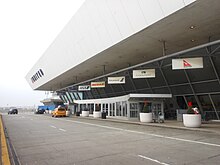
Terminal 7 – Departure Level
Terminal 7 was designed by GMW Architects and built for BOAC and Air Canada in 1970. Currently operated by British Airways, it is also the only airport terminal operated on US soil by a foreign carrier, although Terminal 1 is operated by a consortium of foreign carriers serving the building.
Airlines operating out of Terminal 7 include Oneworld carriers Alaska Airlines, British Airways, and Iberia; Star Alliance carriers All Nippon Airways, LOT Polish Airlines, and United Airlines; SkyTeam member Aerolíneas Argentinas; and non-alliance carriers Icelandair and Ukraine International Airlines.
Between 1989 and 1991, the terminal was renovated and expanded at a cost of $120 million. The expansion was designed by William Nicholas Bodouva + Associates, Architects. In 1997, the Port Authority approved British Airways’ plans to renovate and expand the terminal. The $250 million project was designed by Corgan Associates and was completed in 2003. The renovated terminal has 12 gates.
In 2015, British Airways extended its lease on the terminal through 2022, with an option of a further three years. BA also planned to spend $65 million to renovate the terminal. Despite being operated by British Airways, a major A380 operator, Terminal 7 is not currently able to handle the aircraft type. As a result, British Airways cannot operate A380s on the lucrative London-Heathrow to New York flights, even though in 2014 there was an advertising campaign that British Airways was going to do so. However, British Airways plans to join its Oneworld partners in Terminal 8, and it will not exercise its lease options on Terminal 7. When BA vacates the terminal, the Port Authority has chosen JFK Millennium Partners, a consortium including JetBlue, RXR Realty, and Vantage Airport Group to operate, and eventually demolish, the current terminal while it builds a new Terminal 6 to serve as a direct replacement.
In late 2020 United Airlines announced they would be returning to JFK in February 2021 after a 5-year hiatus. As of Sunday, March 28, 2021, United operates transcontinental nonstop service from Terminal 7 to its west coast hubs in San Francisco and Los Angeles.
Terminal 8

Inside the security checkpoint of Terminal 8
Terminal 8 is a major Oneworld hub with American operating its hub here. In 1999, American Airlines began an eight-year program to build the largest passenger terminal at JFK, designed by DMJM Aviation to replace both Terminal 8 and Terminal 9. The new terminal was built in four phases, which involved the construction of a new midfield concourse and demolition of old Terminals 8 and 9. It was opened in stages between 2005 and its official opening in August 2007.[135] American Airlines, the third-largest carrier at JFK, manages Terminal 8 and is the largest carrier at the terminal. Some Oneworld airlines that operate out of Terminal 8 include Cathay Pacific, Finnair, Qantas, Qatar Airways, and Royal Jordanian Airlines, as well as Star Alliance carrier Ethiopian Airlines.
British Airways plans to move into Terminal 8 on December 1, 2022 following its renovation and expansion.
On January 7, 2020, construction began on expanding and improving Terminal 8. The construction is estimated to be completed in 2022. British Airways will move into Terminal 8 following the construction and will provide 14 daily flights to London. This construction is the first phase in an overall plan to renovate JFK airport.
The terminal is twice the size of Madison Square Garden. It offers dozens of retail and food outlets, 84 ticket counters, 44 self-service kiosks, 10 security checkpoint lanes, and a U.S. Customs and Border Protection facility that can process more than 1,600 people an hour. Terminal 8 has an annual capacity of 12.8M passengers. It has two American Airlines Admirals Clubs and a Flagship Lounge for premium class passengers.
Terminal 8 has 29 gates: 12 gates in Concourse B (1–8, 10, 12, 14 and 16) and 17 gates in Concourse C (31–47). Gate 31 is further subdivided into 5 regional service gates for small jets, 31A–31E. Gate 32 is subdivided into 4 regional service gates for small jets, 32F–32I. The total number of jetbridges is, therefore, 36. Passenger access to and from Concourse C is by a tunnel that includes moving walkways.
Former terminals
JFK Airport was originally built with ten terminals, compared to the six it has today. Ten terminals remained until the late 1990s, then nine remained until the early 2000s, followed by eight until 2011 and seven until 2013.
Eastern Air Lines terminal
This terminal opened in 1959 and was demolished in 1995 after the collapse of Eastern Air Lines in 1991. The terminal was on the site of today’s Terminal 1.[139]
Terminal 3 (Worldport)
Main article: Worldport (Pan Am)
Terminal 3 opened as the Worldport in 1960 for Pan American; it expanded after the introduction of the Boeing 747 in 1970. After Pan Am’s demise in 1991 Delta Air Lines took over ownership of the terminal and was its only occupant until its closure in 2013. It had a connector to Terminal 2, Delta’s other terminal, used mainly for domestic flights. Terminal 3 had 16 Jetway equipped gates: 1–10, 12, 14–18 with two hardstand gates (Gate 11) and a helipad on Taxiway KK.
A $1.2 billion project was completed in 2013, under which Terminal 4 was expanded and with Delta subsequently moving its T3 operations to T4.
On May 23, 2013, the final departure from the terminal, Delta Air Lines Flight 268, a Boeing 747-400 to Tel Aviv Ben Gurion Airport, departed from Gate 6 at 11:25 p.m. local time. The terminal ceased operations on May 24, 2013, 53 years to the day from when it opened on May 24, 1960.[140] Demolition began soon thereafter and was completed by Summer 2014. The site where Terminal 3 used to stand is now used for aircraft parking by Delta Air Lines.
There has been large media outcry, particularly in other countries, over the demolition of the Worldport. Several online petitions requesting the restoration of the original ‘flying saucer’ gained popularity.
International Arrivals Building (Original Terminal 4)
The International Arrivals Building (IAB) was opened in 1957, and was replaced with current Terminal 4 in 2001.
Terminal 6 (Sundrome)
Main article: Sundrome
Terminal 6 had 14 gates. It opened as the Sundrome in 1970 for National Airlines. National was the tenant of this terminal until it was fully acquired by Pan American World Airways in 1980.

JetBlue flight departing with New York City Skyline visible in distance
Trans World Airlines then expanded into the terminal, referring to it as the “TWA Terminal Annex”, later called “TWA Domestic Terminal”. It was eventually connected to the TWA Flight Center. Later, after TWA reduced flights at JFK, Terminal 6 was used by United Airlines, ATA Airlines, a reincarnated Pan American Airways (1996–1998), Carnival Air Lines, Vanguard Airlines, and America West Airlines.
In 2000, JetBlue began service from Terminal 6, later opening a temporary complex in 2006 that increased its capacity by adding seven gates. Until 2008, JetBlue was the tenant of Terminal 6. It became vacant on October 22, 2008, when JetBlue moved to Terminal 5, and finally demolished in 2011.[145] The international arrivals annex of Terminal 5 now uses a portion of the site, and the rest of the site is used for aircraft parking by both JetBlue and British Airways (which operates from nearby Terminal 7), but will be occupied by the new Terminal 6, an annex to Terminal 5, planned to be fully opened by 2027.
Terminal 8 (1960)
The original Terminal 8 opened in 1960; its stained-glass façade was the largest in existence at the time. It was always used by American Airlines and in later years it was used by other Oneworld airlines that did not use Terminal 7. This terminal was demolished in 2007–2008 and replaced with a new Terminal 8.
Terminal 9
Terminal 9 opened in 1959 and was used by United Airlines and Delta Air Lines.[39] Delta moved to Terminal 2 when it acquired Northeast Airlines in 1972. Braniff moved from Terminal 2 to Terminal 9 in 1973, and operated in Terminal 9 until its bankruptcy in 1982. United used Terminal 9 from its opening in 1959 until it vacated the terminal in 1991 and became a tenant at British Airways’ Terminal 7. Terminal 9 then became the home of American Airlines’ domestic operations and American Eagle flights for the remainder of its life. This terminal was demolished in 2007–2008 and replaced with a new Terminal 8.
Tower Air terminal
The Tower Air terminal, unlike other terminals at JFK airport, sat outside the Central Terminals area in Building 213 in Cargo Area A. Originally used by Pan Am until the expansion of the Worldport (later Terminal 3), it was later used by Tower Air and TWA shuttle until the airline was acquired by American Airlines in 2001. Building 213 has not been used since 2000. It is located next to the Delta Air Lines employees’ parking lot number 7, which was once the Tower Air terminal parking lot.
Runways and taxiways
The airport covers 5,200 acres or 21 square kilometers (8.1 sq mi). Over 25 miles (40 km) of paved taxiways allow aircraft to move around the airfield. The standard width of these taxiways is 75 feet (23 m), with 25 feet (7.6 m) heavy-duty shoulders and 25-foot (7.6 m) erosion control pavement on each side. The taxiways have are generally of asphalt concrete composition 15 to 18 inches (380 to 460 mm) thick. Painted markings, lighted signage, and embedded pavement lighting including runway status lights provide both position and directional information for taxiing aircraft. There are four runways (two pairs of parallel runways) surrounding the airport’s central terminal area.
Operational facilities
Air Navigation
The Air Traffic Control Tower, designed by Pei Cobb Freed & Partners and constructed on the ramp-side of Terminal 4, began full FAA operations in October 1994. An Airport Surface Detection Equipment (ASDE) radar unit sits atop the tower. At the time of its completion, the JFK tower, at 320 feet (98 m), was the world’s tallest control tower.[154] It was subsequently displaced from that position by towers at other airports in both the United States and overseas, including those at Hartsfield–Jackson Atlanta International Airport, currently the tallest tower at any U.S. airport, at 398 feet (121 m) and at KLIA2 in Kuala Lumpur, Malaysia, currently the world’s tallest control tower at 438 feet (134 m).
A VOR-DME station, identified as JFK, is located on the airport property between runway 4R/22L and runway 4L/22R.
Physical Plant
JFK is supplied with electricity by the Kennedy International Airport Power Plant, owned and operated by Calpine Corporation. The natural gas-fired electric cogeneration facility uses two General Electric LM6000 gas turbine engines to supply a total of 110 megawatts, which is purchased by the Port Authority for airport operations. Excess energy is also sold to the New York Independent System Operator. The 45,000 ft2 (4,180 m2) facility was authorized in 1990, designed by RMJM, and first entered commercial service in February 1995.
Heating and cooling for all of JFK’s passenger terminals is provided by a co-located Central Heating and Refrigeration Plant (CHRP) in conjunction with a Thermal Distribution System (TDS) which entered service in August 1994. Waste heat from the power plant powers two heat recovery steam generators and a 25 megawatt steam turbine, which in-turn run chillers to generate 28,000 tons of refrigeration, or heat exchangers to generate 225 million Btu/hour.
Aviation Ground Service
Aircraft service facilities include seven aircraft hangars, an engine overhaul building, a 32-million-US-gallon (120,000 m3) aircraft fuel storage facility and a truck garage. Fixed-base operation service for general aviation flights is provided by Sheltair, which possesses the airport’s sole helipad.
Other facilities
The airport hosts an extensive array of numbered administrative, government, and air cargo support buildings. In 2002, the New York metropolitan area accounted for 18 percent of import (and over 24 percent of all) air cargo volume in the nation. At that time, JFK itself was reported to have 4.5 million ft2 (418,064 m2) of warehouse space with another 434,000 ft2 (40,320 m2) under construction.
All From Wikipedia. Main Page
Musement, Book tickets and experiences all over the world
Top Hotels in New York
Lowest Price offers of flights
Prices for flights in the current month
Search Flights on map
Top Flights Deals to Famous Destinations